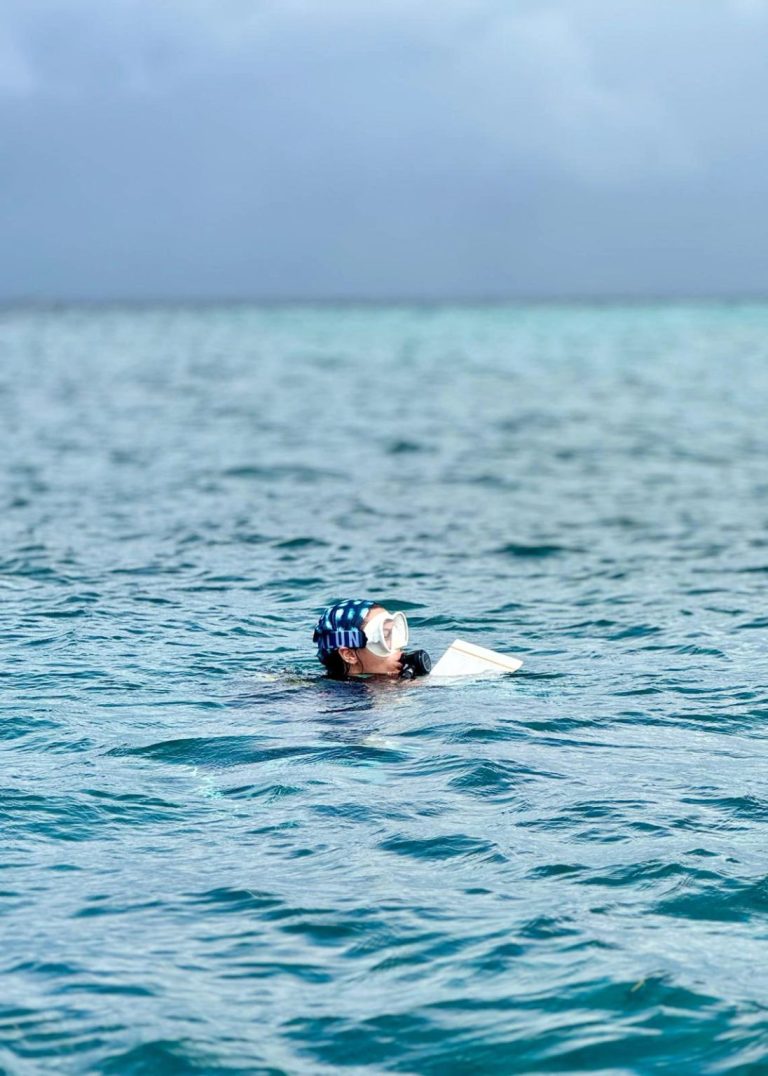
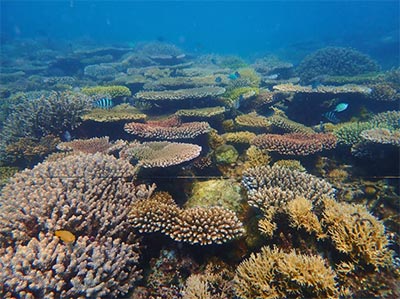
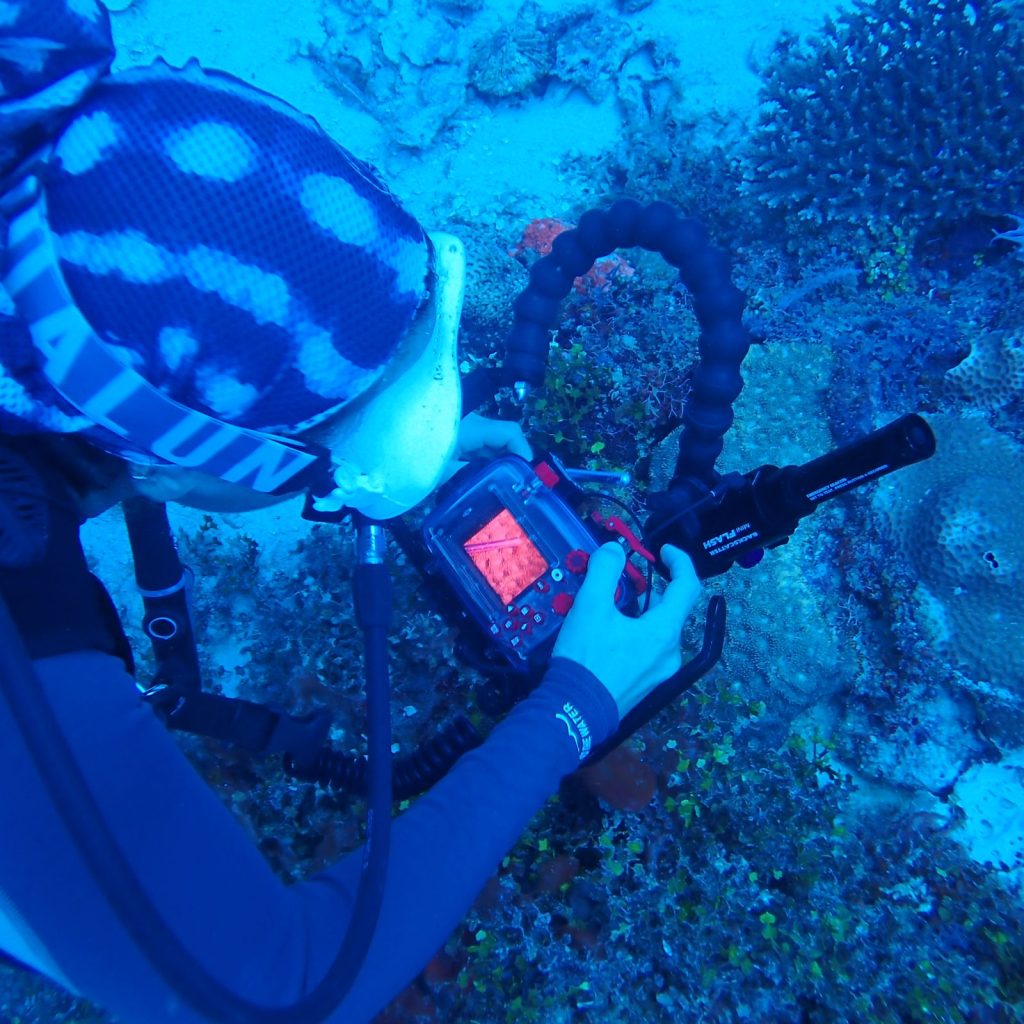
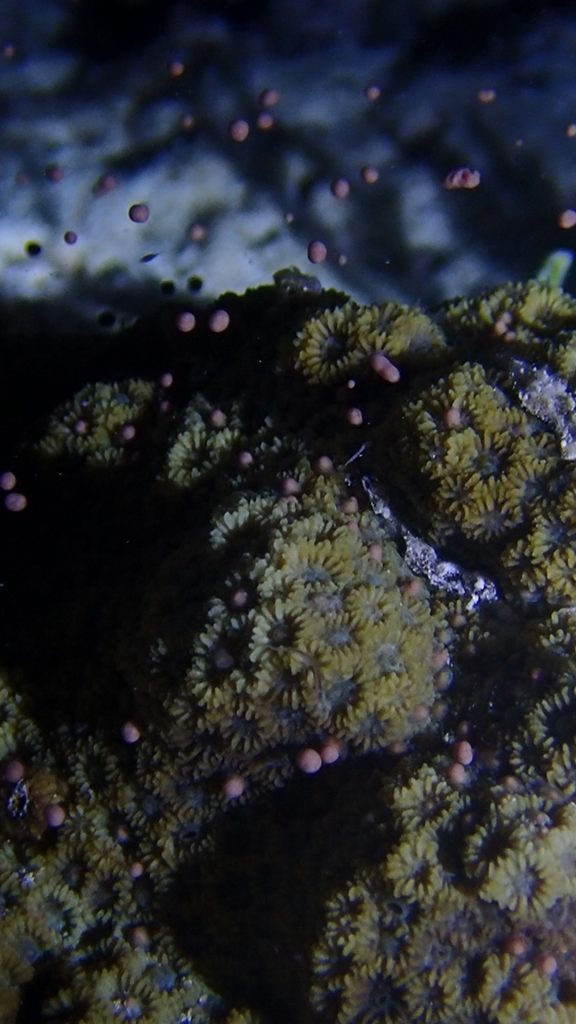
Margot Webster hovers above a coral reef off Jambiani, on Zanzibar’s south-east coast, watching for the smallest sign of change. Then it happens: the colony releases tiny pink spheres, gamete bundles carrying eggs and sperm, which drift slowly upward through the water.
“It is a truly magical sight to witness,” she says, “and a hopeful sign for the reef’s potential for recovery.”
Margot was in Jambiani to monitor spawning with Ashlee, a scientist Blue Alliance collaborates with on coral reproduction. Back in Pemba, where she has spent the past year leading Blue Alliance’s marine science programme, the team recorded what are, to Margot’s knowledge, the island’s first observations of coral spawning. On one night dive, they saw corals “setting”, with gametes visible in the corals’ mouths, ready for release. On a separate daytime dive, they saw a coral release sperm. For Margot, these moments emphasised the importance of the work.
An Ocean That Belongs to Everyone
Originally from France, Margot is drawn to the ocean by its scale and its diversity. No other environment on Earth, she points out, holds such a range of ecosystems and species, including countless strange and remarkable creatures. Diving brings her joy and peace, and she considers herself fortunate to have explored some of the world’s most beautiful coral reefs.
She is equally aware of how much is at stake. In her view, the importance and fragility of ocean ecosystems, particularly coral reefs, are widely underestimated.
“To me, the ocean is the ultimate common good,” she says. “It is boundless, it belongs to all and to no one, and it must be protected so that it stays bountiful for future generations.”

From Intern to Marine Lead
Margot first arrived in Pemba in 2024 as a Blue Alliance intern, completing a placement for her Master’s degree in Ocean Science, Conservation and Innovation (MARRES) at Université Côte d’Azur. Over three months, she worked alongside the local team to monitor the development and impact of the fourth global coral bleaching event on Pemba’s reefs, while also helping with dive training and other field activities.
After graduating, she was invited back to lead the marine science programme in the Pemba Channel Conservation Area (PECCA). Her central task as Marine Lead has been capacity building: equipping the local science team to run scientific monitoring independently.
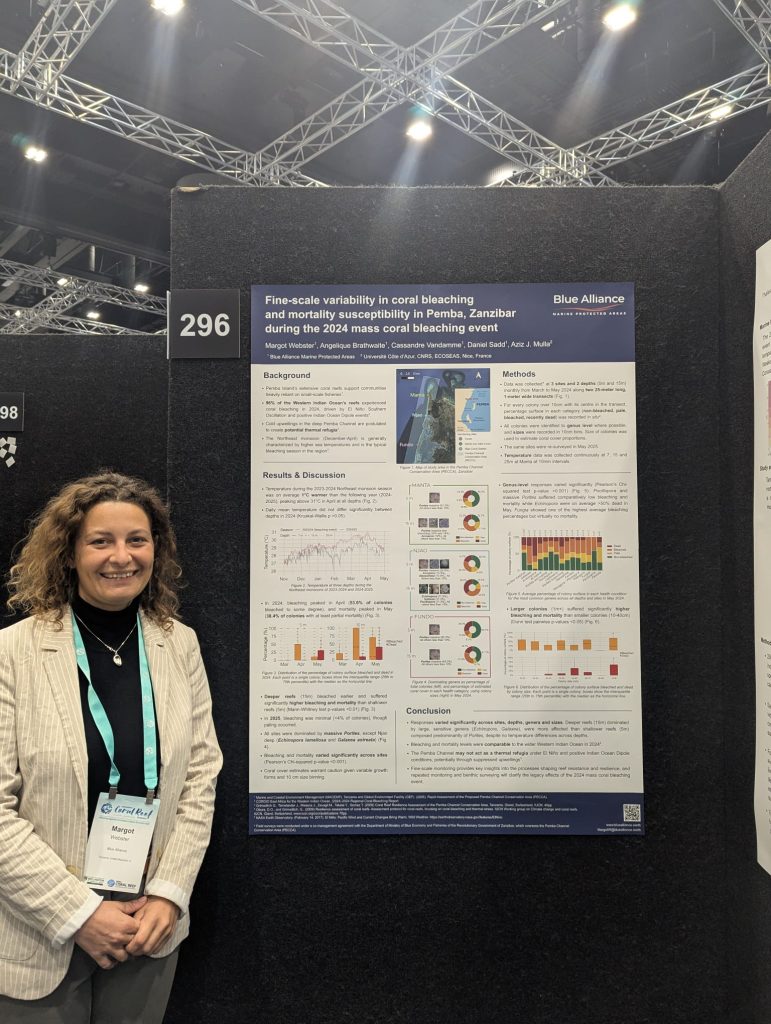
That has meant scuba diving training and support with data collection and management across every monitoring programme, from reef health and commercial fish surveys to experimental catch per unit effort (eCPUE), Crown-of-Thorns Starfish monitoring and turtle nest relocations. Margot has also introduced new protocols and data collection methods, trained the team to use them, and supported local staff with budgeting and work plans. Beyond the field, she attends scientific conferences, works with seaweed farming groups, coordinates school visits and collaborates with other stakeholders and NGOs.



A Day Set by Tides and Moons
In Pemba, no two weeks look the same. Some monitoring takes place every month, while other fieldwork is tied to specific times of year and timed around seasons, lunar cycles and tides.
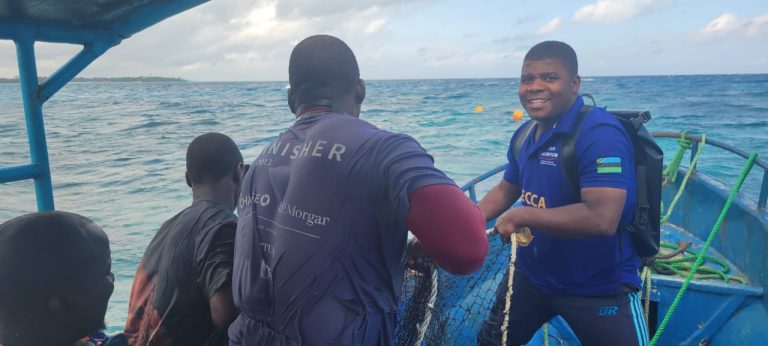
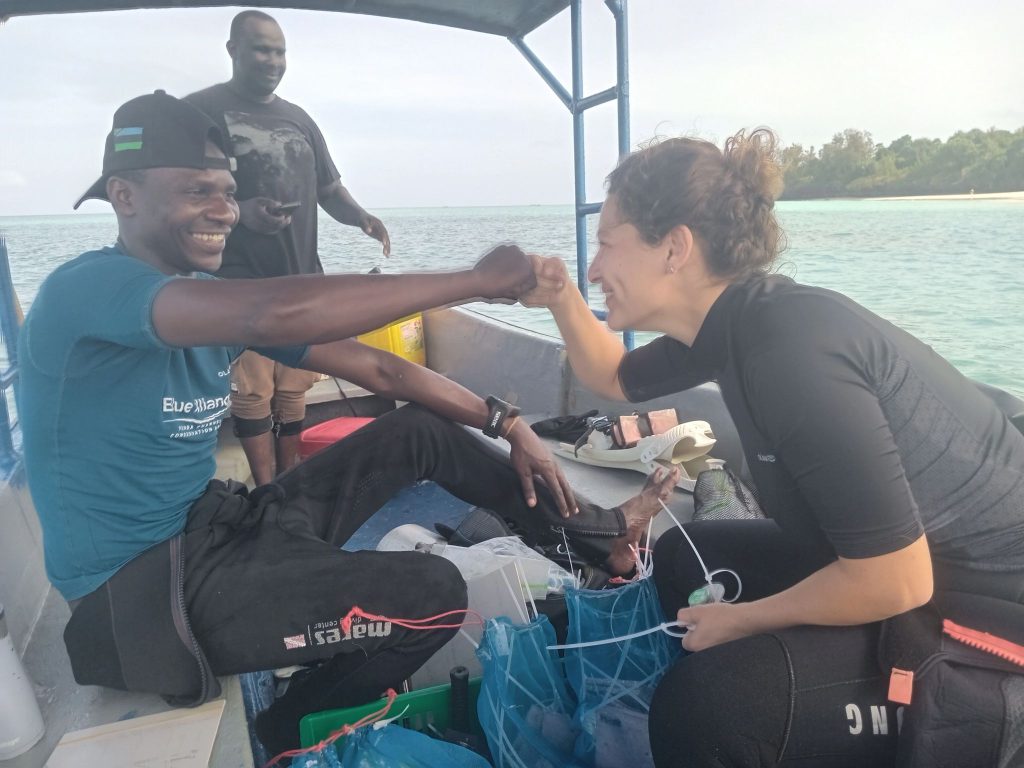
A typical field day begins with a motorbike ride from Makangale village to the Manta Resort, Blue Alliance’s partner and home to the team’s dive base. There, Margot and her colleagues Haji and Suleiman set up their gear and load equipment onto the boat. Depending on the day’s sites, the journey can take ten minutes or an hour and a half. On a good day, dolphins join them on the way.
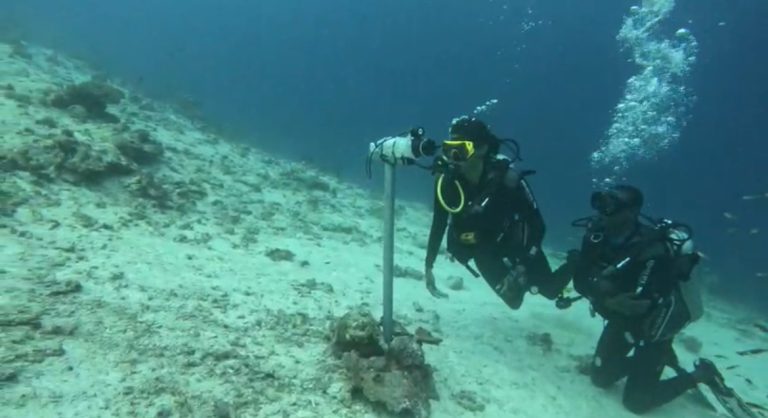
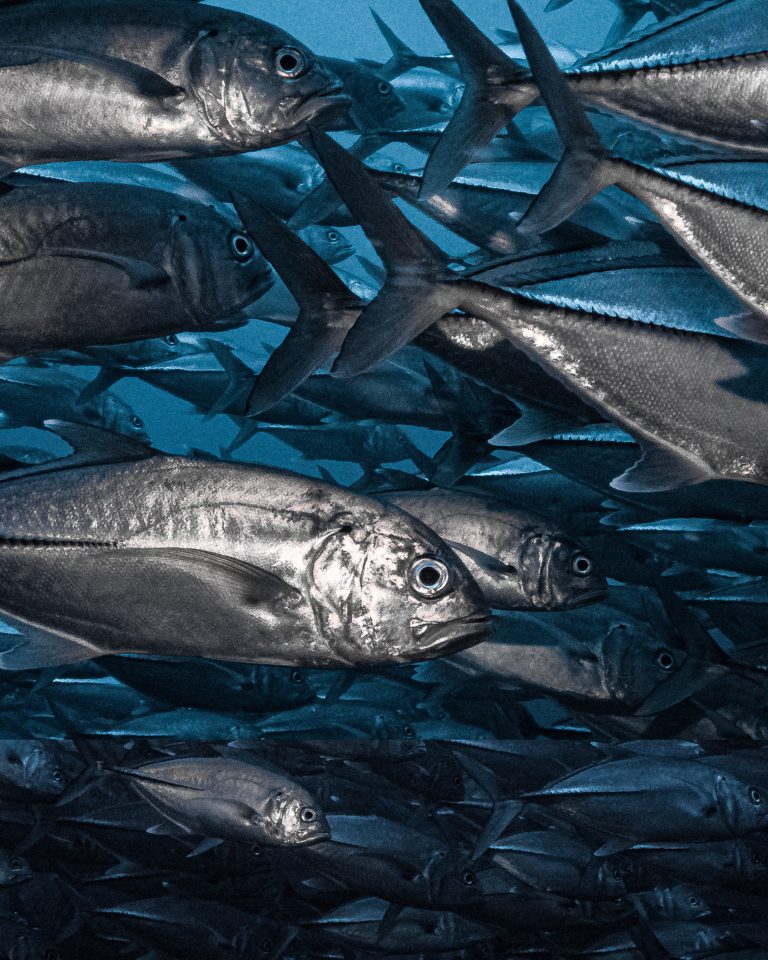
Using GPS, the team guides the captain to each precise monitoring location, checks the current and kits up. Underwater, they might record the abundance, size and family of commercially targeted fish along transects, photograph the reef in sequence for later analysis of reef health, or collect coral settlement tiles to look for newly settled coral larvae.
Most field days include two dives. Between them, the team rests on a nearby beach for an hour, warming up in the sun, reviewing the first dive’s data and preparing for the second. Afterwards, it is back to the Manta Resort to clean the gear, followed by an afternoon of data entry, data cleaning, analysis, reporting and administration.
During coral spawning season, the day can end with a night dive, the team watching closely for the moment colonies release their gametes.

Pride in the Team
Ask Margot what she is most proud of, and she points not to her own work but to her colleagues.
Haji began as a fisher before joining Blue Alliance’s enforcement team as a ranger. Suleiman recently moved to the science team from Aquahub, Blue Alliance’s aquaculture enterprise. Sabrina leads administrative and out-of-water activities. Through training and sustained effort, the team is now competent across a wide range of monitoring protocols and scientific activities.
“It makes me very proud to see them excel in areas that were completely new to them just a year ago,” Margot says. “I am very happy to have contributed to Blue Alliance’s mission in Pemba and to strengthening in-country expertise.”
Patience in a Wild Place
The work is not without obstacles. Pemba’s remoteness brings frequent power cuts and difficulty sourcing materials for scientific work. Margot has also adapted to language barriers and cultural differences that shape both daily life and how work gets done. And fieldwork at sea is inherently unpredictable, with high waves and strong currents capable of changing plans at short notice.
Her approach is simple: patience and flexibility.
“Working across languages and cultures, and in a wild environment, means that things do not always go exactly as planned,” she says. “Being able to adapt the plan quickly is what allows the work to get done in the end.”

The Next Chapter
Margot is now stepping into a new role on Blue Alliance’s international team as Principal Scientist. Working closely with the Director of Science and Conservation and the local science teams, she will oversee and support scientific activities across all of Blue Alliance’s managed MPAs in Tanzania, Indonesia and the Philippines, both remotely and on the ground. That portfolio spans reef health, fisheries management, coral reproduction, water quality, socio-ecological assessment and more.
She is looking forward to seeing the work underway at the other sites. While many of Blue Alliance’s activities are standardised across countries, each location brings its own ecological conditions, cultures and logistical challenges.
Pemba will remain close to her heart. Margot plans to keep supporting the team as they carry forward the work they started together, building the local expertise that keeps PECCA’s reefs monitored, understood and protected, and advancing Blue Alliance’s mission: Regenerating the ocean at scale, for people and nature.
“Regenerating the ocean at Scale – For People and Nature.”